Powered by Blogger.
Showing posts with label tech-updates. Show all posts

Google's Project Ara To Reveals Modular Smartphone

Google's Project Ara To Reveals Modular Smartphone

Google’s phone firm Motorola has declared a brand new project which will permit users to make their own standard smartphone. Project Ara can let users get a plastic phone structure, named endoskeleton, so add-on modules like a keyboard, battery or alternative sensors, giving them flexibility to customize the phone.

Motorola is functioning with the Dutch designer Dave Hakkens, who has created Phonebloks, a standard phone plan. during a web log post Motorola disclosed it had been engaged on the project for quite a year and added: “We need to try to to for hardware what the automaton platform has in deep trouble software system – produce a spirited, third-party developer system.”

“To provide you with the facility to choose what your phone will, however it's, wherever and what it’s product of, what proportion it prices and the way long you’ll keep it,” the post continued.

The endoskeleton or the frame of the phone will hold all the chosen modules in place.

“A module will be something from a brand new application processor to a brand new show or keyboard, an additional battery, a pulse measuring instrument – or one thing not nonetheless thought of,” the firm aforesaid.
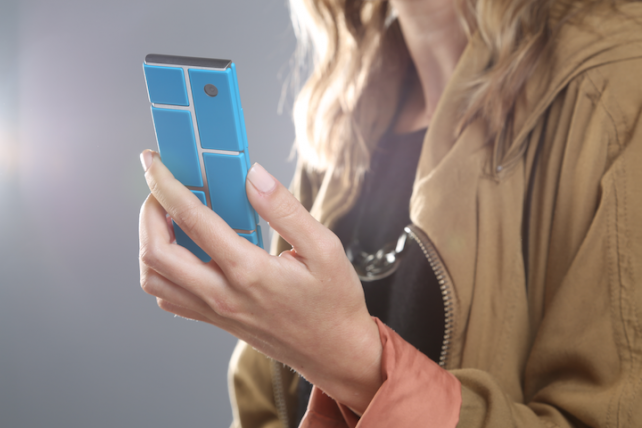
Project Ara

A “Gimmick”


Although some are viewing Project Ara as a breakthrough, there also are those that feel it's all somewhat pointless.

Principal technology analyst at Davies white potato cluster, Chris inexperienced, feels the project is simply a “gimmick”.

“I don’t see this as being a giant deal. it's not responding to any specific demand and there's no real profit to aggregation your own device,” he said. “The days of DIY IT, individuals building their own desktop computer, are gone as a result of falling prices of hardware.”

Motorola’s next step is to ask developers to make the modules, which can be followed by a module developer’s kit.

Li-Fi: Alternate Of Wi-Fi Transmits Data 250 Times Faster Than Broadband

The quickest speed antecedent re-portable was 3Gbit/s, achieved earlier this year by the Fraunhofer physicist Institute in European nation. Chinese researchers conjointly claimed this month to possess created a 150 Mbp/s association; however some consultants were uncertain while not seeing any proof.
Li-Fi Technology is Alternate Of Wi-Fi

The term Li-Fi was coined by capital University's academician Harald Haas throughout a plug-ugly speak in the technology is additionally called actinic ray communications. 

Many consultants claim that Li-Fi represents the longer term of mobile web because of its reduced prices and larger potency compared to ancient Wi-Fi.

Both Wi-Fi and Li-Fi transmits information over the spectrum, however whereas Wi-Fi utilizes radio waves, Li-Fi uses actinic ray. This is often a definite advantage therein the actinic ray is much additional plentiful than the radio-frequency spectrum (10,000 times additional in fact) and may reach so much larger information density.
About Lifi Technology

Li-Fi signals work by shift bulbs on and off improbably quickly – too quickly to be detected by the human eye. This most up-to-date breakthrough builds upon this by victimization little micro-LED bulbs to stream many lines of knowledge in parallel.

The analysis was dole out by the radical Parallel actinic ray Communications project, a venture between the schools of Oxford, Cambridge, Edinburgh, St Andrews and Strathclyde, and funded by the Engineering and Physical Sciences analysis Council.

Existing junction rectifier lightweight bulbs may be reborn to transmit Li-Fi signals with one semiconductor unit, and also the technology would even be of use in things wherever radio frequencies can't be used for worry of busy with electronic equipment.

And though Li-Fi bulbs would have to be compelled to be unbroken on to transmit information, the bulbs may be dim to the purpose that they weren't visible to humans and however still useful. One draw-back is that the information receiver would have to be compelled to be seeable of the transmitter-bulb as actinic ray doesn't penetrate solid materials.

The makers of Li-Fi note that this quality may truly be a bonus in some eventualities, creating Li-Fi safer than Wi-Fi with hackers unable to access unsecured web connections from out of sight of the transmitter.

Storage Disk To Store Million Year Data Unveiled

Storage Disk To Store Million Year Data Unveiled

Nano-technologists have currently designed and engineered a storage disk that may store data for 1,000,000 years or additional. The point frame is nearly incomprehensible compared to the present magnetic laborious disks that may store knowledge for simply over a decade.

Back in 1956, IBM was the primary company within the world to introduce an advertisement laptop capable of storing knowledge on a memory device drive. The IBM 305 RAMAC used fifty 24-inch discs to store up to five MB of knowledge. Today, laborious drives haven't any drawback storing knowledge with general capacities of one TB obtainable on a three.5-inch disk. Despite this huge increase in storage capability, things haven’t very modified. The lifetime of knowledge that may be hold on on magnetic discs remains some ten years. The question is, however will we tend to preserve data on a timescale larger than that?

Well, Jeroen DE Vries at the University of Twente within the The Netherlands and colleagues have designed and engineered a disk capable of storing knowledge over one million years. they need performed accelerated ageing tests showing that the disk ought to be ready to store knowledge for one million years and perhaps longer.

The idea behind fast the method of ageing is predicated round the undeniable fact that knowledge should be hold on in Associate in Nursing energy minimum that's separated from alternative minima by Associate in Nursing energy barrier. thus to corrupt knowledge by changing a zero to a one, for instance, needs enough energy to beat this barrier. The chance that the system can jump during this method is ruled by a principle referred to as Svante August Arrhenius law. This relates the chance of jumping the barrier with factors like temperature and therefore the Boltzmann constant and the way usually a jump are often created, that is relative to the amount of atomic vibrations.

Calculations reveal for knowledge to last 1,000,000 years, the specified energy barrier is sixty three KBT or seventy KBT to last a billion years. “These values square measure well among the vary of today’s technology,” say DE Vries. To prove now, the team engineered a disk capable of storing data for this era of your time. the information is hold on within the pattern of lines incised into a skinny metal disc so coated with a protecting layer. 

The metal they used was wolfram, that they selected due to its high melting temperature (3,422 degrees C) and low thermal enlargement constant. The protecting layer used is Si compound (Si3N4), chosen due to its high resistance to fracture and its low thermal enlargement constant.

The disk was mistreatment normal patterning techniques and hold on knowledge within the sort of QR codes with lines 100nm wide. The disk was then heated at varied temperatures to check however the information would be affected. The results, though dispensed in specific laboratory conditions, square measure spectacular. in keeping with Svante August Arrhenius law, a disk capable of living 1,000,000 years should survive one hour at 445 Kelvin, a check that the new disks passed with no issues. 

Actually, the disks survived temperatures up to 848 Kelvin, though with major amounts of data loss. That compares well with the Rosetta Project, a proposal by the Long currently Foundation to make deposit materials capable of storing knowledge for periods larger than ten,000 years.

This suggests we tend to could to be ready to preserve a big quantity of data for future man mistreatment this method.

Livescribe 3 Pen Sends Your Handwriting To Your IPad

Livescribe 3 Pen Review

When I first saw an ad for Livescribe some years ago, I remember thinking just how good kids these days have it. Back in the day, we had to be creative to find out ways to jot down notes as fast as our professors in school spat out ideas. Today, students can use tablets, laptops, phones, and Livescribe pens to take care of that. And for those who actually like to write notes the old school way – pen and paper – but also appreciate the power of technology, there is the Livescribe 3 Smartpen.

The core idea is simple: you write on paper, and what you write will appear on your screen. Just like magic, huh?

Of course, the magical aspect is based on technology, and part of that requires you having Anoto-based Livescribe Dot paper. Unfortunately, you can’t just use any kind of notebook.

Right now, the Livescribe 3 pen is only compatible with the iPhone and iPad (running on iOS 7), so if you’re an Android user, you won’t be able to take advantage of this groundbreaking technology. For now. The company has said that the Android version will be available next year.
About Livescribe 3 Pen

How does the Livescribe 3 send your handwritten notes to your iOS device?


It uses LE Bluetooth 4.0 (LE = low energy), giving the pen 14 hours of juice. When you run out, you’ll need two hours for a full charge.

For students who like sharing notes (or professionals who have to share – meeting minutes, perhaps), the Livescribe 3 also allows sending documents to others.

You can choose between the Livescribe 3 Smartpen and the Livescribe 3 Smartpen Pro Edition, with the former selling for $149.95 and the latter for $199.95.

[via: TechBeat]

Convert Your Feelings in Textures with Disney Touchscreen

Disney Touchscreen Lets You Feel Textures

“Rendering 3D tactile features on touch surfaces” – that’s how Disney Research describes their new creation. While many of my generation would probably think Ariel, Belle, and all the other not-your-usual princesses of our childhood, this new development will certainly catch the attention of any tech head, Disney princess fan or not. And, it does what it says on the tin: the technology will allow users to actually feel what’s displayed on the screen.

How do they do it?


It’s all about friction, that irritating force of nature that brings about a lot of complications in other applications. In this case, however, friction made it possible for the brilliant Disney minds to make this touchscreen. From the Disney Research press release:

“Our brain perceives the 3D bump on a surface mostly from information that it receives via skin stretching,” said Ivan Poupyrev, who directs Disney Research, Pittsburgh’s Interaction Group.  “Therefore, if we can artificially stretch skin on a finger as it slides on the touch screen, the brain will be fooled into thinking an actual physical bump is on a touch screen even though the touch surface is completely smooth.”

Bottom line: It’s all about tricking our brains into thinking we’re feeling things.
Convert Your Feelings in Textures with Disney Touchscreen

Applications


We don’t need to have Einstein’s IQ to see the potential of this technology, do we?

Imagine playing Infinity Blade (1, 2, or 3 – it doesn’t matter) on your iPad with its awesome graphics. Now imagine having the additional tactile feedback. Any other gaming tablet with this feature would be very welcome as well!

How about exploring a topographical map or a 3D view of a place you want to visit? Again, add a tactile aspect to that.

Then there’s the education sector, which is already a huge “fan” of using tablets in the classroom. Imagine all the applications that can be taken to the next level with this kind of touchscreen!

This is interesting, at the very least. Here’s a video for more details.


Popular Posts